
Hello folks!
From now on we'll post stuff on the much nicer Wordpress system.
Please bookmark this link: http://firstcask.com/blog
Slaters then!
Saturday, 14 February 2009

Psychogeographical attempt

In today's post you'll learn how to rediscover your own neighbourhood for free!
Ingredients needed:
- a piece of paper
- a pen (a pencil will work as well)
- a car, or a motorbike, or a bicycle
- your best mate
- beer
Facultative:
- dice (if you're uninspired)
Now try the following:
Sit down with your mate, open a tin and decide of your directions by choosing lefts and rights in advance (at least 30 or so). Write it down on the sheet of paper. Invent yourself a couple of rules in case you end up in a dead end or something. Now go an follow strictly your planned journey. A surprise awaits you at the end! Satisfied or money back! Reports will be listed here and best rewarded by a Firstcask testpressing of your choice!
Nota: keep at least a couple of beers until the all process is done in case you need to give it to a farmer who gonna get you out of the mud with his tractor. No joke, this is experience speaking.
Friday, 13 February 2009
Magnetic paint stronger than expected
Our first and probably last attempt to acheive a "loudspeaker wall" ended up in an implosion process described by Nikola Tesla at the time.
Implosion is a suctional process that causes matter to move inwards, not outwards as in the case of explosion. This inward (centripetal) motion, however, does not follow a straight (radial) path to the centre, it follows a spiralling whirling path. This is called a vortex and is the secret of nature. Though, in our test we didn't get either a working speaker or a regular vortex. It makes us as dubitative as the guy who lent us his house for the experiment! Any implanation welcome!


Implosion is a suctional process that causes matter to move inwards, not outwards as in the case of explosion. This inward (centripetal) motion, however, does not follow a straight (radial) path to the centre, it follows a spiralling whirling path. This is called a vortex and is the secret of nature. Though, in our test we didn't get either a working speaker or a regular vortex. It makes us as dubitative as the guy who lent us his house for the experiment! Any implanation welcome!


Thursday, 12 February 2009
LINGVA PRAVORVM PERIBIT - Tong of depraved people will perish!

A behind the scene reported story about cat number FSK007. We cannot guarantee that the following information is either relevant or accurate.
"A friend came to my house and we talked on my roof for ever enjoying wine and sunset, he told me he knew an old geezer living in the mountains of France he was making a film about. The geezer was a leader in the situationist movement (also prominent memeber of post-dadaïsm, surrealism, Cobra, Oulipo, Satrape, Collège de Pataphysique, OU-X-Po, Psychogeography), and has loads of unreleased material about French lettrists. We said lets get some recordings of this if we can, six months of difficult but pleasurable bartering and bargaining later, here is the result, co-produced by agent FSK007 and Videoconference". This is the only info we could collect from the internet...
It has been said and heard around that the two original cassettes have been collected in Brussels, shipped to Berlin, cut by a fantome engineer on an unattended session, shipped again to France? for duplication before being spread around mostly undercover. It is remarkable that all the reference numbers have been scratched out of the vinyl, the cover bringing no additional info. Though some Ubuweb people received a virgin untouched copy... Here is what they say:
Notes
Tracks 1-6:
SITUATIONISTEN
DOUBLE-7"
BOOTLEG
NO LABELS, NO ARTWORK
PERSONELL: GUY DEBORD + ?
DATE: ???
SCRATCHINGS:
A) FSK 007 A.45
B) FSK 007 B.45
C) FSK 007 + VIDEOCONFERENCE C.45
D) FSK 007 D.33
A DISCLAIMER ABOUT SITUATIONISTEN
One of UbuWeb's viewers, an astute Debord scholar who would rather remain anonymous disputes the authenticity of SITUATIONISTEN. We are enclosing his comments. We'll leave the MP3s up and leave it to you to decide for yourself:
"As for the Situationisten double LP, I have to say, I'm pretty sceptical that Debord had anything to do with any of this. It sounds more like the Lettrists, or possibly the Danish/German breakaway faction of the Situationists, but more likely the lettrists because the accents seem to be French. I don't recognize any voice which sounds like Debord's voice, which is pretty distinctive. All of this is to say, it's not impossible, because the world is full of wierd surprises, but my gut reaction is that this is either a bad gag or some repackaged Lettrists recordings and someone has called them "Situationist" for their own purposes, or because they lump the two together and don't know any better. By the time the Situs had formed, I think Debord had totally abandoned working in this mode and I have never seen any evidence that he worked in this mode even when he was part of the Lettrists or the Lettrist International. It's more characteristic of the early work of Gil Wollman and others.
I don't get any links from the FSK things so I'm not sure what they are. I can't hear them and don't know about them. I thought they were some kind of notations for the "Situationisten" lp. If so, then my comments above would apply.
I don't have the Greil Marcus cd, but he seems to have known Debord or at least had some access, so I don't think he'd put stuff out that was too questionable. However, the Hurlements track reads like a bad joke: since actually a 35mm print with optical sound would have lots of clicks and pops however silent. At best, it is a conceptual recreation of Part of the Track of Hurlements. Hurlements, as you probably know, did have plenty of voices as well as a preponderance of silence. Or perhaps the clicks and pops were cut out by whoever mastered the cd, or by whoever created the mp3s.
Critique of separation is possibly authentic, though its source is questionable. For the most part Debord worked with voice over and music separated. Having the music in the background and the short length of the sample suggests to me it may have come from a French Radio show about Debord and the situationists that was produced several years ago. It has copious extracts from the sound tracks of Debord's films and it's sometimes hard to tell where their transitions are superimposed on the original material. The voice however is unmistakeably Debord's, whereever it comes from.
A second follow-up: A friend who saw a screening of Hurlements last year in France reports to me that during the "silent" parts of the film, there were "creaking sounds" and "strange glitches." So, my guess would be that the bit of track on the cd is a hypothetical reconstruction of the "silent" part of the track rather than an actual "quotation" of the track. Silent passages in analog sound films are never effectively "silent" the way a digital track can be and Hurlements almost certainly had a 35mm optical sound track. Other possibilities are extremely remote."
Listen to the stuff on Ubuweb.
Multiple Sidosis 1970 by Sid Laverents
Splitscreens, overdubbing, yukulele, whisteling, ... A great classic amongst us!


Since its release in 1970 (originally screened for the San Diego Amateur Moviemakers Club, but eventually distributed to amateur film societies internationally) the nine minute “technical comedy” has won a wallfull of awards and honors, climaxing in 2000 when the Library of Congress selected it as the only amateur film to be entered into the National Film Registry, ensuring it’s preservation and place in history for as long as America exists.
More on Sid's filmography and discography on this page.


Since its release in 1970 (originally screened for the San Diego Amateur Moviemakers Club, but eventually distributed to amateur film societies internationally) the nine minute “technical comedy” has won a wallfull of awards and honors, climaxing in 2000 when the Library of Congress selected it as the only amateur film to be entered into the National Film Registry, ensuring it’s preservation and place in history for as long as America exists.
More on Sid's filmography and discography on this page.
Tuesday, 10 February 2009
Monday, 9 February 2009
Ordinateur XYZ on Ondes Martenot
One of the best library music up to this date has been made by Steve Laurent & Pierre Duclos from France. It seems it was used as a film score for the "La Fayette" film from Jean Dréville in 1961. More info welcome! Anyway, please drop an ear on this fantastic piece of music!
Related info here and go there to download the Sonorop album.
Related info here and go there to download the Sonorop album.
Hang drum
Created in 2000, the Hang (pronounced "hung") is one of the youngest musical instruments. It comes from Bern, Switzerland, and was created by Felix Rohner and Sabina Schärer OF THE PANArt Company. It was the result of many years of research on the steel pan and many other resonating percussion instruments from around the world: Gong, Gamelan, Ghatam, drums, cowbells, MUSICAL Saw...
More info at PANArt webby.
More info at PANArt webby.
Saturday, 7 February 2009
Friday, 6 February 2009
Luanda 2009 Kuduro rave style!


Worldwide known, thanks to Buraka Som Sistema, Kuduro gets it right when it's about dancing. Actually there is some stories around that this dance style has been originally inspired by Jean-Claude Vandamme... Just browse Youtube for some gems! They appear as fast as they disappear. So be quick. Some cute ones below...
Burakas here!
CALL OUT!!!
"To challenge someone in some way. Or to put someone on blast:
I don't think you've really lost 300 pounds - you just say you have. Produce some Before & After photos. I'm calling you out!"
I don't think you've really lost 300 pounds - you just say you have. Produce some Before & After photos. I'm calling you out!"
Hey guys, you're now reading us from all around the globe (yeah, the line is circular and slides along the equator, globally), as well as listening to our music, apart from Antarctica, or really deep into Sahara, or North Korea and China (though we know you're out there m8z!).
So why not submit some stuff you want us to post, so that the other parts of the planet can share the knowledge?
Send us emails guys, or post your intentions in the comments, we're all up to learn some new things!!!
p.s.: we're not suffering of a lack of things to post, at all, there's shitloads more to come, but we're expecting, and would really really, really, love some global participation and common sharing....
Come on the crew!!!! Let's rave!!! And scroll down the page!!!
THE MORE, THE MERRIER!
Thursday, 5 February 2009
Wednesday, 4 February 2009
Welcome to:
Our new readers from Dominica, Slovakia, and Denmark.
And oops, we forgot to mention Spain in the previous post...
And oops, we forgot to mention Spain in the previous post...
Amazing restoration project...
Between 1938 and 1942, the Hammond Organ Company was selling the Novachord, considered by some as the first real polyphonic synthesizer available on the market.

It's 72 notes polyphonic, amazingly ALL TUBES!!!
It has oscillators, filters, VCAs, envelope generators, and
a frequency divider...

A bit more than a thousand units were build, it was huge, heavy, and very fragile. Imagine yourself getting your hands on one these beast, and having to restore it: 72 notes, all tubes, really old components with toxic stuff in them...
Phil Cirocco at CMS got one, but as he says: "the sheer number of components and it's complexity, make properly restoring a Novachord, a Herculean task..."
Well, he managed to do it!!!
This guy is completely crazy, or a Genius, or probably both...
You'll find some sound samples at the bottom of the page, recorded right after restoration, and they are properly amazing, mind boggling, unbelievable, incredible, whatever you call them.
Scroll down a bit more and you'll find his conclusion about this job, it's truly freaky.
Oh, and Phil Cirocco is considered to be the foremost ARP guy in the world...

It's 72 notes polyphonic, amazingly ALL TUBES!!!
It has oscillators, filters, VCAs, envelope generators, and
a frequency divider...

A bit more than a thousand units were build, it was huge, heavy, and very fragile. Imagine yourself getting your hands on one these beast, and having to restore it: 72 notes, all tubes, really old components with toxic stuff in them...
Phil Cirocco at CMS got one, but as he says: "the sheer number of components and it's complexity, make properly restoring a Novachord, a Herculean task..."
Well, he managed to do it!!!
This guy is completely crazy, or a Genius, or probably both...
You'll find some sound samples at the bottom of the page, recorded right after restoration, and they are properly amazing, mind boggling, unbelievable, incredible, whatever you call them.
Scroll down a bit more and you'll find his conclusion about this job, it's truly freaky.
Oh, and Phil Cirocco is considered to be the foremost ARP guy in the world...
Tuesday, 3 February 2009
A pretty rare cutting lathe
When he was young, Les Paul (the legendary Gibson guy), was cutting acetates in his bedroom on portable devices such as Presto lathes.
There's many different Presto models and cutterheads, but a very interesting one is the portable system designed by the BBC during WWII.
But Les Paul didn't only design guitars and cut records, he also designed a cutting lathe...
It's the Arcturus:

Just click on the pictures for a much better resolution.

Very little is known about this machine, but what we know so far is that the turntable platter is a Cadillac flywheel!!! And that it also has wood bearings... Mounted on this lathe is a very very rare Van Epps cutterhead, extremely little is known on that one too.
Apparently Arcturus Company was (or is?) based in Los Angeles, hard to find info about it...
Could anybody help?
There's many different Presto models and cutterheads, but a very interesting one is the portable system designed by the BBC during WWII.
But Les Paul didn't only design guitars and cut records, he also designed a cutting lathe...
It's the Arcturus:

Just click on the pictures for a much better resolution.

Very little is known about this machine, but what we know so far is that the turntable platter is a Cadillac flywheel!!! And that it also has wood bearings... Mounted on this lathe is a very very rare Van Epps cutterhead, extremely little is known on that one too.
Apparently Arcturus Company was (or is?) based in Los Angeles, hard to find info about it...
Could anybody help?
Sunday, 1 February 2009
A space beacon called Oscar

Oscar-1
Since the very first OSCAR satellites (OSCAR stands for Orbiting Satellite Carrying Amateur Radio) were launched in the early 1960s, AMSAT's international volunteers, often working quite literally in their basements and garages, have pioneered a wide variety of new communications technologies that are now taken for granted in the world's satellite marketplace. These breakthroughs have included some of the very first satellite voice transponders as well as highly advanced digital "store-and-forward" messaging transponder techniques.

Beacons. Early amateur satellites carried only one-way radio beacons which sent down telemetry information about conditions of satellite equipment and the space environment to anybody interested in receiving the data. Hamsats of the 21st century still have such beacon transmitters, alongside their high-tech two-way communications transponders.

However, the thought of a "repeater in space" developed and launched by a group of "know-nothing Hams" working in their basements and garages wasn't always looked upon with favor. While details of the incident are sketchy, it's reported that the builders of TELSTAR I, the first commercial telecommunications satellite, were quite upset to learn that a "rag-tag" group of Hams were also working on a telecommunications satellite called OSCAR III as TELSTAR was nearing completion. For a while, it appeared that OSCAR III might possibly upstage their multi-million dollar TELSTAR effort by beating them to orbit! In fact, it's also reported that TELSTAR's builders did eventually change their public relations approach to include the word "commercial" in subsequent references to TELSTAR I as the "world's first telecommunications satellite".

History of amateur satellite site.
List of amateur satellites.
More at project Oscar page.
Selected references taken from the Amsat website:
Davidoff,  Martin,  The Satellite Experimenter's
       Handbook  Newington, CT: The American
       Radio Relay League,  1984.

Jansson,  Richard,  Spacecraft Technology Trends
        in the Amateur Satellite Service,  Ogden, UT:
        Proceedings of the 1st Annual USU Conference
        on Small Satellites,  1987.
Saturday, 31 January 2009
You are reading us:
From 30 different countries so far, and that’s well cool…
Here’s the list, arranged by decreasing amount of readers by country:
Belgium, United Kingdom, United States, Germany, Finland, Canada, Lithuania, Sweden, Japan, Netherlands, France, Austria, Portugal, Australia, Greece, Hungary, India, Argentina, Ireland, Switzerland, Italy, Chile, Poland, Bangladesh, South Korea, Indonesia, Brazil, Turkey, Norway, and last but not least: Romania.
U.S. gained the third place about a week ago, did anything happen over there recently? And we’re still missing some readers from Gaza, Baghdad, Cuba and Pyongyang. Come on guys, spread the word !!!
Here’s the list, arranged by decreasing amount of readers by country:
Belgium, United Kingdom, United States, Germany, Finland, Canada, Lithuania, Sweden, Japan, Netherlands, France, Austria, Portugal, Australia, Greece, Hungary, India, Argentina, Ireland, Switzerland, Italy, Chile, Poland, Bangladesh, South Korea, Indonesia, Brazil, Turkey, Norway, and last but not least: Romania.
U.S. gained the third place about a week ago, did anything happen over there recently? And we’re still missing some readers from Gaza, Baghdad, Cuba and Pyongyang. Come on guys, spread the word !!!
Friday, 30 January 2009
Ceephax "Exidy Tours" first artwork
Back in 2003 we released Andy's "Exidy Tours". Well this drawings he made before he finally choosed the cover you know. Actually, "Exidy Tours" was first called "The Last Ferry" as a tribute to the numerous fast drives on the E40 motorway in order to get the last ferry to England from Ostend. There is also some artwork for the "Last Ferry" album but can't get hold on it right now. It was some typewriting a bit like on the released album but black and white made on a mechanical machine. A typewriting wallet sort of thing. I remember Andy typing a huge amount of characters almost everywhere possible. Wayfaring writer...


Wednesday, 28 January 2009
Superheterodyne principles
The superheterodyne method found applications in early electronic musical instruments, in radio or even in the brand new Hypersonic (HSS) speakers. So we think some basics here may be appropriate!
The principles of beat frequency or heterodyning oscillators were discovered by chance during the first decades of the twentieth century by radio engineers experimenting with radio vacuum tubes. Heterodyning effect is created by two high radio frequency sound waves of similar but varying frequency combining and creating a lower audible frequency, equal to the difference between the two radio frequencies (approximately 20 Hz to 20,000 Hz). the musical potential of the effect was noted by several engineers and designers including Maurice Martenot, Nikolay Obukhov, Armand Givelet and Leon (or Lev) Sergeivitch Termen the Russian Cellist and electronic engineer.
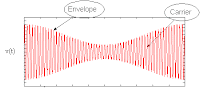
What Superheterodyning is
The principles of beat frequency or heterodyning oscillators were discovered by chance during the first decades of the twentieth century by radio engineers experimenting with radio vacuum tubes. Heterodyning effect is created by two high radio frequency sound waves of similar but varying frequency combining and creating a lower audible frequency, equal to the difference between the two radio frequencies (approximately 20 Hz to 20,000 Hz). the musical potential of the effect was noted by several engineers and designers including Maurice Martenot, Nikolay Obukhov, Armand Givelet and Leon (or Lev) Sergeivitch Termen the Russian Cellist and electronic engineer.

What Superheterodyning is
When you use the lower side-band (the difference between the two frequencies), you are superheterodyning. Strictly speaking, the term superheterodyne refers to creating a beat frequency that is lower than the original signal. Although we have used the example of amplitude modulation side-bands as an example, we are not talking about encoding information for transmission. What superheterodying does is to purposely mix in another frequency in the receiver, so as to reduce the signal frequency prior to processing. Why and how this is done will be discussed below.
We have discussed that superheterodyning is simply reducing the incoming signal is frequency by mixing. In a radio application we are reducing the AM or FM signal which is centered on the carrier frequency to some intermediate value, called the IF (intermediate frequency). For practical purposes, the superheterodyne receiver always reduces to the same value of IF. To accomplish this requires that we be able to continuously vary the frequency being mixed into the signal so as to keep the difference the same. Here's what the superheterodyne receiver looks like:

This is essentially the conventional receiver with the addition of a mixer and local oscillator. The local oscillator is linked to the tuner because they both must vary with the carrier frequency. For example, suppose you want to tune in a TV station at 235 MHz. The band-pass filter (which only permits signals in a small range about the center frequency to pass) must be centered at 235 MHz (or slightly higher in SSB). The local oscillator must be set to a frequency that will heterodyne the 235 MHz to the desired IF of 452 kHz (typical). This means the local oscillator must be set to 234.448 MHz (or alternatively to 235.452 MHz) so that the difference frequency will be exactly 452 kHz. The local oscillator must be capable of varying the frequency over the same range as the tuner; in fact, they vary the same amount. Therefore, the tuner and the local oscillator are linked so they operate together.
Advantages of Using Superheterodyning
Now, we easily see that this type of receiver can be constructed, but for what purpose? All we have accomplished is to reduce the frequency to the IF value. We still must process the signal as before. So why are so many receivers using the superheterodyne method? There are three main advantages, depending on the application used for:
- It reduces the signal from very high frequency sources where ordinary components wouldn't work (like in a radar receiver).
- It allows many components to operate at a fixed frequency (IF section) and therefore they can be optimized or made more inexpensively.
- It can be used to improve signal isolation by arithmetic selectivity
Reduction in frequency
AT very extremely high frequencies, many ordinary components cease to function. Although we see many computer systems that work at previously unattainable frequencies like 166 MHz, you certainly never see any system that works at radar frequencies like 10 GHz (try that Intel!). There are many physical reasons for this, but suffice it to say, it can't be done (yet). So the designer of a radar interceptor (fuzz-buster, et al.) is faced with a daunting circumstance unless he/she can use a superheterodyne receiver to knock down the frequency to an IF value. It is in fact, the local oscillator (a operating at radar frequencies) of the superheterodyne radar receiver that makes your radar detector detectable by the police (in VA for example, where the use of radar detectors are illegal).
Optimization of Components
It is a typical engineering dilemma: how to make components that have outstanding performance, but can also cover a wide range of frequencies. Again, the details aren't important, but the problem is very real. A possible solution to this, is to make as much of the receiver as possible always work at the same frequency (the IF). This is accomplished by using the superheterodyne method. The majority of components can be optimized to work at the IF without any requirements to cover a wide range of frequencies.
Arithmetic Selectivity
The ability to isolate signals, or reject unwanted ones, is a function of the receiver bandwidth. For example, the band-pass filter in the tuner is what isolates the desired signal from the adjacent ones. In real life, there are frequently sources that can interfere with your signal. The FCC makes frequency assignments that generally prevent this. Depending on the application, you might have a need for very narrow signal isolation. If the performance of your band-pass filter isn't sufficient to accomplish this, the performance can be improve by superheterodyning.
Frequently, the receiver bandwidth is some fraction of the carrier frequency. If your receiver has a bandwidth of 2 % and you are tuned to 850 kHz, then only signals within the range from 2 % above and below are passed. In this case, that would be from 833 to 867 kHz.
Arithmetic selectivity takes that fraction and applies it to the reduced frequency (the IF). For the fixed IF of 452 kHz, that means signals which are superheterodyned to the range of 443 to 461 kHz will pass. Taking this range back up into the carrier band, only carrier frequencies in the range of 841 to 859 kHz will pass. If this is confusing, recall that the local oscillator is set to reduce the 850 kHz to 452 kHz (i.e. must be set at 398 kHz). Thus, the 850 kHz is superheterodyned to 452 kHz. Any adjacent signals are also superheterodyned but remain the same above or below the original signal. An example might clear this up:
Suppose there is an interfering signal at 863 kHz while you are tuned to 850 kHz. A conventional 2 % receiver will pass 833 to 867 kHz and so the interfering signal also passes. The superheterodyne receiver mixes both signals with 398 kHz to produce the desired signal at 452 kHz and the interference at 465 kHz. At 2 %, the IF section only passes 443 to 461 kHz, and therefore the interference is now suppressed. We say that the superheterodyne receiver is more selective. With a little thought, the reason is simple: it operates at a smaller frequency, so the 2 % actually involves a smaller range. That is why it is called arithmetic selectivity. Bandwidths that are expressed as a percentage are smaller when the center frequency is smaller (the same way that 2 % of $10 is less than 2 % of $10,000,000 ).
Whether or not, you need to take advantage of arithmetic selectivity depends on the application. If you have no problems with interference at your current bandwidth and/or it is not difficult or expensive to reduce the bandwidth of your receiver, then you don't need it. However, in cases where selectivity is important or the frequency is very high (like radar) then superheterodyning can greatly improve performance.
- Superheterodyne receivers reduce the signal frequency be mixing in a signal from a local oscillator to produce the intermediate frequency (IF).
- Superheterodyne receivers have better performance because the components can be optimized to work a single intermediate frequency, and can take advantage of arithmetic selectivity.
Wednesday, 21 January 2009


Subscribe to:
Posts (Atom)


 Posts
Posts

